Using Store
介绍
hedzr/Store,是延续 cmdr.v1 的 Option Store 概念,并进行了独立的抽象,
然后在此基础上完全重新设计和实现的配置管理库,
同时它也是一个高性能的内存键值对软件包,并且支持用句点(.)分隔路径的方式构建出来的层次化数据结构。
将 Store 用于实现 http Router,in-memory high-speed Cache 是完全可能的。
在重构 Store 的过程中,我们非常注意尽可能地实现高性能、低碎片分配(几乎零分配)的代码。
Store 的当前实现在性能方面有很好的竞争力。
由于脱胎于 Option Store,所以 Store 理所当然地和 cmdr.v2 进行了紧密的无缝集成。
同时,你还可以从 cmdr.v2 中完全剥离 hedzr/Store 的集成关系。
主要能力
conf := store.New()
conf.Set("app.debug", false)
conf.Set("app.verbose", true)
conf.Set("app.dump", 3)
conf.Set("app.logging.file", "/tmp/1.log")
conf.Set("app.server.start", 5)

ss := conf.WithPrefix("app.logging")
ss.Set("rotate", 6)
ss.Set("words", []any{"a", 1, false})
ss.Set("keys", map[any]any{"a": 3.13, 1.73: "zz", false: true})

// Tag, Comment & Description
conf.Set("app.bool", "[on,off,   true]")
conf.SetComment("app.bool", "desc: a bool slice", "cmmt: remarks here")
conf.SetTag("app.bool", []any{"on", "off", true})

// TTL to clear the node data to zero
conf.SetTTL("app.bool", 15 * time.Second, func(_ *radix.TTL[any], nd radix.Node[any]) {
  t.Logf("%q (%q) cleared", "app.bool", nd.Data())
})  // since v1.2.5
defer conf.Close()  // when you used SetTTL, the Close() is must be had.

// Set/create a node at once by SetEx()
conf.SetEx("app.logging.auto-stop", true,
  func(path string, oldData any, node radix.Node[any], trie radix.Trie[any]) {
    trie.SetTTL(path, 30*time.Minute,
      func(s *radix.TTL[any], node radix.Node[any]) {
          trie.Remove(node.Key()) // erase the key with the node
      })
    // Or:
    trie.SetTTLFast(node, 3*time.Second, nil)
    // Or:
    node.SetTTL(3*time.Second, trie, nil)
  })

// inspect it
states.Env().SetNoColorMode(true) // to disable ansi escape sequences in dump output
fmt.Println(conf.Dump())The dumping result looks like (internal data structure):
  app.                          <B>
    d                           <B>
      ebug                      <L> app.debug => false
      ump                       <L> app.dump => 3
    verbose                     <L> app.verbose => true
    logging.                    <B>
      file                      <L> app.logging.file => /tmp/1.log
      rotate                    <L> app.logging.rotate => 6
      words                     <L> app.logging.words => [a 1 false]
      keys                      <L> app.logging.keys => map[a:3.13 1.73:zz false:true]
    server.start                <L> app.server.start => 5
bool <L> app.bool => [on,off, true] // remarks here | tag = [on off true] ~ a bool sliceAs you seen, the internal structure will be printed out for the deep researching.
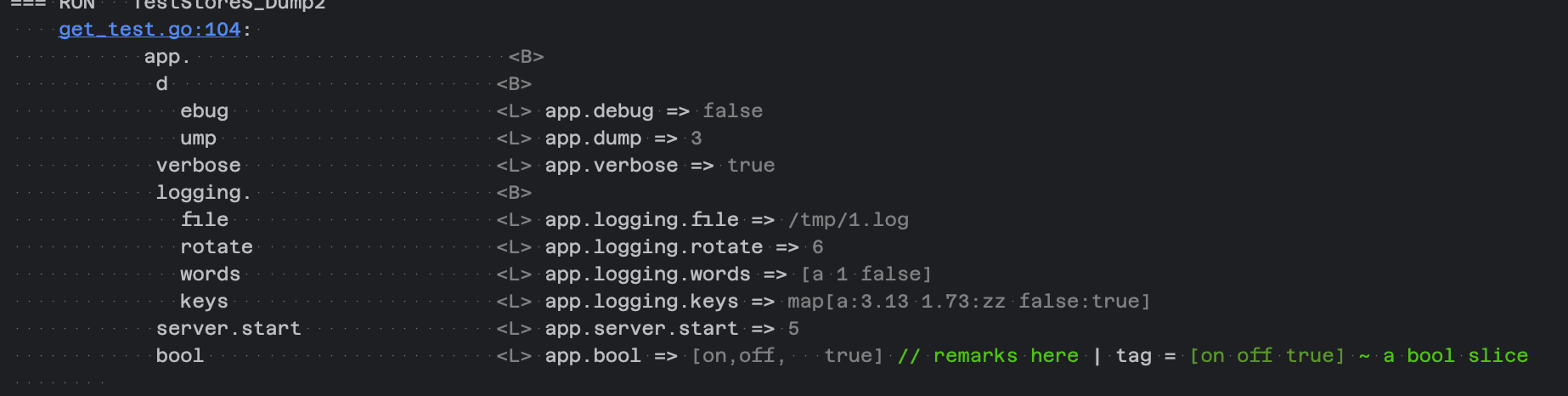
<B> is branch, <L> is leaf.
Leaf node contains data, comment, description and tag (any value).
To speed up the tree, any delimiter char is a part of the path.
The store provides advanced APIs to extract the typed data from some a node,
iData := conf.MustInt("app.logging.rotate")
stringData := conf.MustString("app.logging.rotate")
debugMode := conf.MustBool("app.debug")
...The searching tools are also used to locate whether a key exists or not:
found := conf.Has("app.logging.rotate")
node, isBranch, isPartialMatched, found := conf.Locate("app.logging.rotate")
t.Logf("%v | %s | %v | | %v, %v, found", node.Data(), node.Comment(), node.Tag(), isBranch, isPartialMatched, found)Locate is a more friendly Has test for the developers when they want to inspect more extra information after searching.
内幕
Store 经过了完全的重设计,其核心数据结构基于 Trie-tree 的改进版 Radix-tree,在每个节点中存储其路径片段而不是限于每个节点单个字符,也不采用传统 Trie-tree 的 children [256]char 的设计方式。传统方式以 ASCII 字符表为预设支持,用固定数据来表达下级节点,这不仅失去了 Unicode 支持能力,也比较浪费内存,同时由于每个节点只表示路径字符串的一个字符,所以有更高的深度和更慢的搜索匹配速度。
改进的 Radix-tree 通常允许在每个节点存储一个多字符的路径片段,有效地压缩了 trie node 深度,加速了搜索性能。进一步地,由于我们存储的是 []rune,因此在 Unicode 支持上是完备的。
在上面的运行时输出中,你可以探究 Store 的内部结构。
Learn More
Manual of `hedzr/store`
`hedzr/store` on Github
`hedzr/logg` on Github
`hedzr/evendeep` on Github
`hedzr/is` on Github
What is Next?
How is this guide?
最后更新于